Why Is Medicai the Best for Vendor-neutral Archive?
Many hospitals still manage separate PACS systems that cannot exchange studies without manual exports or vendor-specific connectors. Each added location multiplies the number of logins, backup schedules, and support contracts that must be maintained.
By the end of this article you will know how Medicai's cloud PACS and vendor-neutral archive collapse those separate systems into one platform, what the backup and disaster-recovery functions actually cover, and whether the listed pricing plans match the scale of your imaging volume and multi-site requirements.
What Is Medicai?
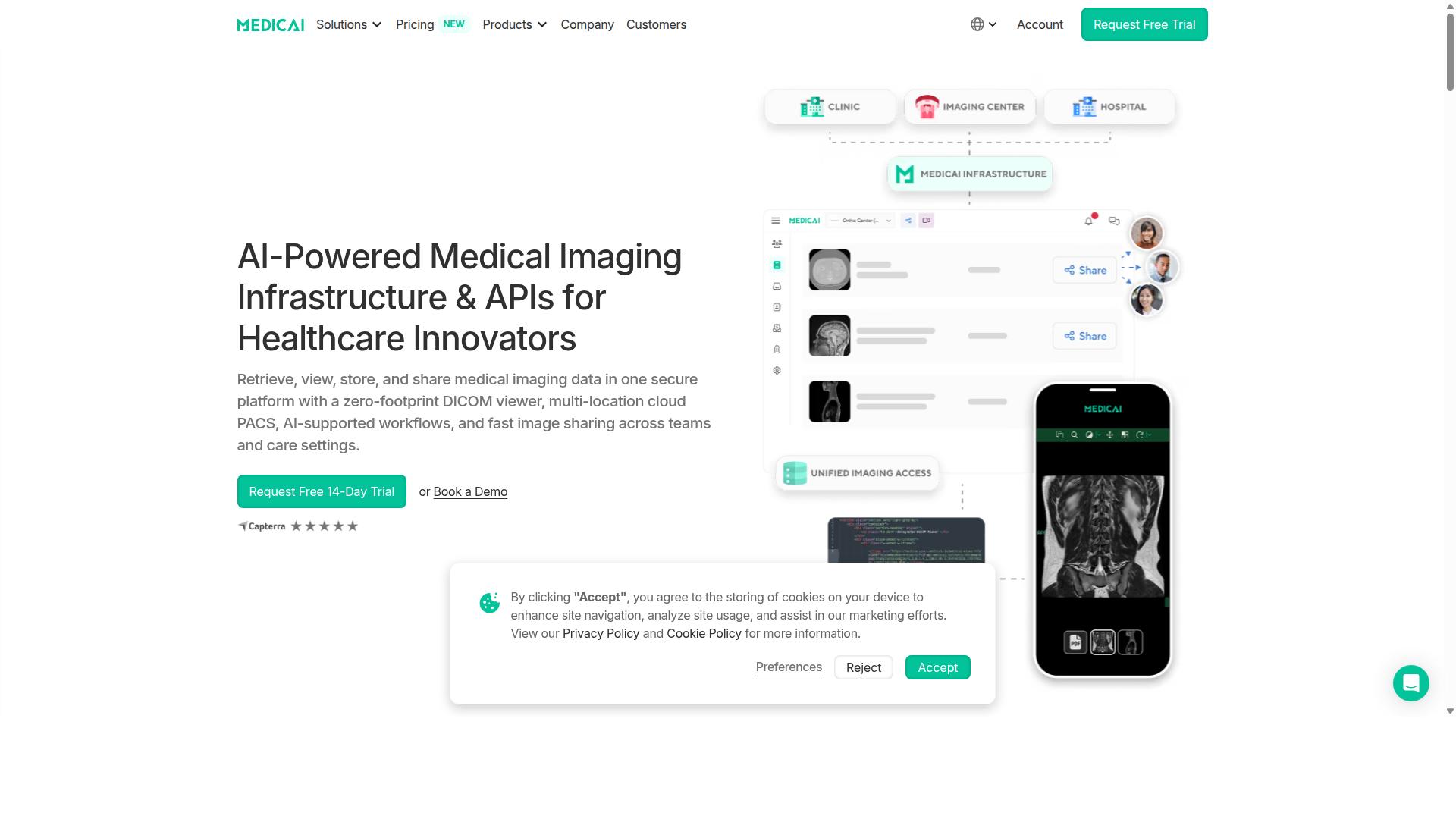
Medicai is a cloud-based medical imaging platform that enables healthcare providers to retrieve, view, store, and share imaging data in one secure environment.
The platform features a zero-footprint DICOM viewer that requires no local software installation. This design allows radiologists and clinicians to access studies from any web browser while maintaining data security.
Medicai functions as a central hub for DICOM studies by consolidating data from multiple PACS systems into a single, unified archive. Hospitals and imaging centers use this capability to connect several legacy systems without replacing existing infrastructure.
Many facilities face challenges when different departments run separate PACS solutions. Medicai addresses this by providing multi-location cloud PACS that brings all studies into one accessible location for review and collaboration.
Imaging centers often maintain equipment from various manufacturers, each with its own storage format. The platform supports Imaging Infrastructure as a Service (IIaaS) to standardize these different sources into a consistent, vendor-neutral archive.
Healthcare organizations use Medicai to create a single point of access for patient imaging across departments and locations. This approach reduces the need to maintain separate archives while supporting AI-supported workflows that can analyze studies from the consolidated repository.
Why Medicai Is the Best Vendor-Neutral Archive
A true vendor-neutral archive removes dependence on proprietary PACS hardware and software. This independence gives healthcare organizations control over their imaging data. Organizations can choose any compliant system without being locked into a single vendor.
Non-proprietary formats store DICOM objects in standard directory structures that any compliant system can read. These formats use open standards instead of closed architectures. Data remains accessible regardless of future vendor changes.
Legacy PACS systems often trap organizations in expensive contracts. Migration paths allow healthcare facilities to move data without disrupting clinical operations. Standard directory structures make these transitions straightforward and predictable.
Vendor lock-in creates ongoing costs beyond initial licensing fees. Organizations pay premium prices for maintenance and upgrades that depend on proprietary systems. Vendor-neutral archives eliminate these recurring expenses by maintaining data independence.
Standard directory structures support multiple deployment options. Organizations can choose cloud storage or maintain on-premise solutions based on their requirements. This flexibility reduces infrastructure costs while maintaining data ownership.
Data migration becomes simpler when archives follow open standards. Healthcare IT teams can transfer imaging studies between systems without custom conversion tools. This capability reduces both time and expense during system transitions.
Multi-vendor support allows radiology departments to select best-of-breed solutions for specific needs. Organizations combine different imaging modalities and viewing applications without compatibility concerns. Interoperability becomes the foundation for efficient workflow management.
Long-term archiving benefits from vendor independence. Data remains readable and accessible even as technology evolves over decades. Organizations avoid the risk of losing access to historical studies due to vendor discontinuation.
Key Features and What Makes Medicai Stand Out
Medicai combines enterprise imaging capabilities with modern cloud infrastructure and open standards. This approach helps healthcare facilities avoid vendor lock-in while maintaining full control over their medical imaging data. The platform supports both cloud storage and on-premise deployment options that scale according to organizational needs.
Healthcare providers benefit from interoperability that connects different imaging systems without requiring extensive infrastructure changes. Medical imaging workflows remain intact while the underlying storage and access layers improve through standardized communication protocols. This balance matters because facilities need reliable access to patient data without system disruptions during upgrades or migrations.
The architecture supports long-term archiving requirements while enabling immediate image viewing across different departments and locations. Data ownership stays with the healthcare organization throughout the entire lifecycle of medical records.
Cloud PACS and Vendor Neutral Archive
The Cloud PACS layer stores studies in a vendor-neutral archive while still allowing radiologists to read and report from a unified worklist. Integration happens through DICOMweb and HL7/FHIR standards that connect existing PACS systems without replacing current workflows. Automatic modality worklist synchronization keeps patient schedules and imaging requests synchronized across connected systems.
Medicai currently houses 1.7M studies in its vendor-neutral archive, demonstrating the platform's capacity to handle large-scale medical imaging repositories. The architecture supports multi-vendor environments where different imaging modalities and PACS systems coexist within the same facility. This approach eliminates the need for complete system overhauls during technology transitions.
Non-proprietary format storage ensures that data remains accessible regardless of future vendor changes or software updates. Interoperability extends beyond simple file transfer to include structured reporting and patient case management capabilities that work together with existing radiology workflows.
Backup and Disaster Recovery
Every study is replicated across physically separate data centers with automated failover capabilities. Real-time geo-redundant replication ensures that medical imaging data remains available even during localized system failures or natural disasters. The system maintains HIPAA compliance and GDPR compliance throughout all data handling processes.
Configurable retention policies allow healthcare organizations to set storage durations that match their regulatory requirements and clinical needs. Disaster recovery capabilities include documented recovery time objectives that help facilities plan for business continuity scenarios. These specifications matter for radiology departments that require consistent access to patient imaging history during emergency situations.
Role-based access controls and audit trails maintain security standards while enabling authorized personnel to retrieve archived studies during recovery operations. The combination of data encryption and geographically distributed storage provides the foundation for reliable long-term medical record preservation.
Pricing and Plans
Medicai offers transparent monthly subscriptions that scale with storage rather than study volume. This approach helps organizations predict costs more accurately across different imaging volumes. The structure supports vendor-neutral archive requirements without unexpected fees.
The Starter tier costs $249 per month for 500 GB of cloud storage. It includes unlimited user accounts and supports no connected locations. A 14-day trial of these features is available without requiring a credit card.
The Standard tier costs $749 per month for 2 TB of cloud storage. It also includes unlimited user accounts and supports one connected location. Yearly billing reduces these rates to $209 monthly for Starter and $639 monthly for Standard, providing 15 percent savings.
Additional storage blocks can be purchased as needed without long-term contracts. The Enterprise tier offers custom pricing for multiple connected locations and external locations with volume-based options. Per-study pricing is available for enterprise customers.
DICOM Gateway Setup requires a one-time $1,000 fee per location. This modular approach allows organizations to expand their vendor-neutral archive capacity gradually as needs evolve. Refunds are not available for partial billing periods.
Trust Signals
Compliance certifications and measurable platform usage provide objective proof of reliability.
HIPAA and GDPR compliance ensures that patient data stays protected under strict regulatory standards. These attestations demonstrate that Medicai meets the security and privacy requirements demanded by healthcare institutions worldwide.
The zero-footprint viewer carries FDA and CEE clearance, which confirms its safety and effectiveness for clinical use. This clearance allows healthcare providers to trust the viewer for diagnostic purposes without additional validation steps.
Platform activity metrics further reinforce this trust. Medicai processes 50 million API transactions annually and recorded 300 thousand DICOM visualizations in the past year alone. These figures reflect consistent usage across real clinical environments.
The platform now supports 70 clinics and hospitals with over 10 thousand active doctors. This adoption rate shows that healthcare organizations rely on Medicai for secure, vendor-neutral archive management at scale.
Who Should Use Medicai
Any healthcare organization that produces or consumes medical images can benefit from a scalable vendor-neutral archive. Medicai supports hospitals, imaging centers, specialty care providers, virtual care platforms, and teleradiology services.
Multi-site hospitals often face high operational expenses from maintaining separate archives across locations. Medicai offers a single, scalable archive that consolidates imaging data and reduces duplicate infrastructure costs.
Outpatient imaging centers seek cost efficiency without compromising data access. Medicai provides cloud storage with on-premise deployment options and supports interoperability through DICOM, HL7, and FHIR standards.
Specialty groups in orthopedics, oncology, and cardiology benefit from Medicai's multi-vendor support. These practices can avoid vendor lock-in and maintain data ownership while using a non-proprietary format for their long-term archiving needs.
Specialty care providers listed in the brand facts include neurology, radiology, ophthalmology, ob-gyn, pulmonology, dentistry, and gastroenterology. Medicai also serves clinical trials, tumor boards, medical education organizations, and personal injury lawyers who regularly review imaging records.
Patients access their data through the Patient Portal, supporting transparency and care coordination. Medicai's design ensures cross-platform compatibility and maintains compliance with HIPAA compliance and GDPR compliance standards.
By replacing fragmented storage systems with a unified archive, providers reduce archive-related OPEX while preserving image viewing access and radiology workflow efficiency across the enterprise.
Final Verdict
Medicai delivers a genuinely vendor-neutral archive that balances compliance, scalability, and predictable cost. Healthcare organizations gain independence from proprietary systems while maintaining full control over medical imaging data.
The platform supports DICOM, HL7, and FHIR standards to ensure smooth PACS integration across different equipment vendors. This approach eliminates vendor lock-in and simplifies future technology transitions.
Multi-vendor support allows facilities to combine equipment from various manufacturers without compatibility concerns. Data stays accessible regardless of the original imaging source or storage location.
Deployment flexibility includes both cloud storage and on-premise deployment options. Organizations choose the configuration that matches their security policies and infrastructure requirements.
HIPAA compliance and GDPR compliance come standard with data encryption and role-based access controls. Audit trails track every interaction with patient data to meet regulatory requirements.
Data ownership remains with the healthcare provider throughout the relationship. Non-proprietary format storage ensures long-term accessibility without ongoing vendor dependency.
Disaster recovery capabilities protect against data loss while maintaining business continuity. Zero-downtime architecture supports continuous access to critical imaging studies.
Scalability accommodates growing volumes of medical imaging data without performance degradation. The system expands alongside organizational needs and increasing storage demands.
Cost efficiency comes from predictable pricing structures that avoid hidden fees or unexpected charges. Healthcare IT budgets become easier to manage with transparent cost models.
Medicai USA is located at 7901 4th St N, STE 300, St. Petersburg, FL, 33702. Call +1 (832) 220 1035 to schedule a personalized demonstration of the vendor-neutral archive capabilities.
Recommended Resources: